Getting Started: Your Puppy’s First Days at Home
You just brought home the cutest little furball in all of Houston — congrats! Now comes the part nobody talks about in the puppy store: the first few weeks of training. But here’s the good news: you don’t need to be a professional trainer to set your new puppy up for success. Training your puppy is one of the best bonding experiences you’ll ever have, and it starts the moment they walk through your door.
The most important training doesn’t happen in a formal class — it happens in your living room, your backyard, and during your daily routines. From day one, your puppy is absorbing everything: where the food is, what the house rules are, how you react when they chew your favorite sneaker. Consistency is your superpower. Every person in your household needs to use the same commands, enforce the same rules, and react the same way. Mixed signals confuse puppies fast.
Start by building structure into your puppy’s life. Pick a designated potty spot outside. Set a consistent feeding schedule. Decide where your pup will sleep. Structure isn’t about being strict — it’s about helping your puppy feel safe, confident, and secure in their new home. When puppies know what to expect, they learn faster and experience less anxiety. For Houston puppy parents, remember that Texas heat and Gulf Coast humidity mean early mornings and evenings are your best windows for outdoor training sessions. Keep sessions short — 5 to 10 minutes — so your pup stays focused instead of overheated.
The Five Essential Commands to Teach First
When it comes to beginner puppy training, resist the urge to do too much at once. According to the American Kennel Club, start with these five commands and build everything else on top of them. Each command should be introduced one at a time, with lots of repetition and positive rewards.
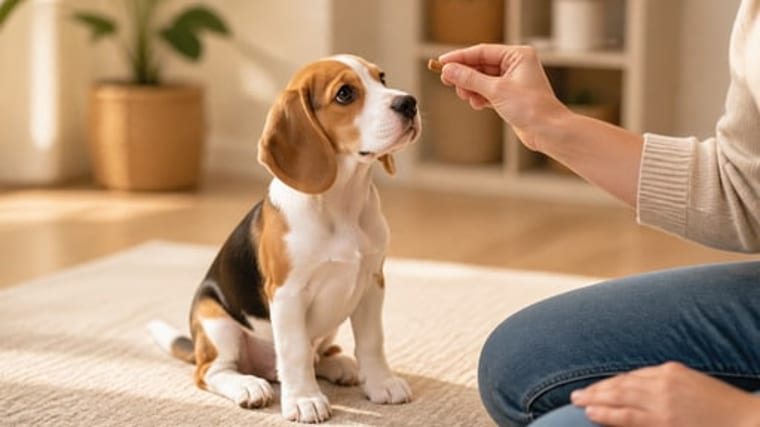
1. Sit — This is often the easiest command to teach and builds your puppy’s confidence. Hold a small, high-value treat (like freeze-dried chicken or liver) near your pup’s nose and slowly move it back over their head. Their bottom naturally lowers as they follow the treat. The moment their rear touches the floor, say “sit” clearly and reward immediately with the treat and enthusiastic praise. Repeat a handful of times per session — keep it fun and short. Never force them physically into position.
2. Come (Recall) — This might be the most important command because it can save your pup’s life one day. Start indoors in quiet areas. Crouch down, open your arms wide, and say “come” in your happiest, most exciting voice. When they come to you, celebrate like they just won a championship. Practice daily in low-distraction environments first, then gradually add distance and mild distractions as they get more reliable. Always make coming to you the most rewarding thing they know.
3. Stay — Build on “sit.” Ask your puppy to sit, hold your palm up like a stop sign, take one small step back, then return and reward immediately. Add distance and duration gradually over days — not hours. Start with just a few seconds, then work up to longer periods. Patience here pays off big later, especially as your puppy grows.
4. Down — From a sitting position, hold a treat close to their chest and slowly move it down toward the floor. As their front end lowers, say “down” and reward. You can also capture this behavior by watching for when they naturally lie down, then marking it with a word like “yes!” and rewarding. Like “sit,” never force them physically into the position.
5. Leave It — Put a low-value treat in your closed fist and let your puppy sniff and paw at your hand. The second they back off or turn away, reward them with a different (higher-value) treat from your other hand. Repeat until they reliably leave things on command — both indoors and out. This command is essential for safety when your puppy encounters something they shouldn’t eat.
Train for two to three short sessions per day, five minutes each. Short sessions beat one long, exhausting marathon every time, especially during those first few weeks when attention spans are tiny and everything is brand new. The goal is to keep your puppy engaged, happy, and excited about learning.
Why Positive Reinforcement Works (And Punishment Doesn’t)
The science is clear: reward-based training works better — especially for small and designer breeds that tend to be more sensitive. The American Veterinary Society of Animal Behavior recommends positive reinforcement as the gold standard for dog training, and you’ll see results in your puppy’s behavior within days.
Here’s the simple version: reward what you want to see, and calmly redirect what you don’t. When your Cavapoo, Maltipoo, or any puppy nails a “sit,” celebrate like they just won a championship — high-pitched praise, a tasty treat, maybe a little happy dance. When they do something you don’t want (like nipping or jumping on guests), a calm, firm “no” and a redirect to the right behavior is all you need.
Punishment — yelling, swatting, or rubbing their nose in accidents — doesn’t just fail to work. It can create anxiety and trust issues that make training harder over time. Your puppy genuinely wants to make you happy. Your job is to clearly show them how.
Timing matters more than anything else. The reward (or the redirect) needs to happen within two seconds of the behavior for your puppy to make the connection. Wait too long and they’ve already moved on to sniffing something else entirely. This is where a marker word like “yes!” or a clicker can be incredibly helpful — it lets you pinpoint the exact moment your puppy is doing the right thing.
Common First-Month Mistakes (and How to Fix Them)
Even the most loving new puppy parents make these slip-ups. Here’s your cheat sheet to avoid the most common pitfalls:
Inconsistent Rules — You let them on the couch Tuesday but scold them for it Friday. Your fix: Decide your house rules before your puppy comes home and get everyone in your household on the same page. Post a simple list if needed.
Too Much Freedom Too Fast — Giving a new puppy the run of your whole apartment is a recipe for accidents and chewed furniture. Your fix: Use a puppy playpen, crate, or baby gates to limit their space at first. Expand their freedom as they earn it with good behavior. This also helps with housetraining.
Missing the Potty Window — Puppies need to go out after every meal, after naps, after playtime — sometimes every 30 to 60 minutes. Your fix: Set a timer and stay consistent with your puppy’s bathroom schedule. Consistency is the foundation of housetraining success.
Skipping Socialization — Training isn’t just commands — it’s exposure to new people, sounds, unfamiliar dogs, and different environments. Your fix: Take your pup to a dog-friendly patio, a neighbor’s backyard, a pet supply store, or a local park. New experiences during the critical first three months build a confident, well-adjusted dog later. The American Veterinary Society of Animal Behavior emphasizes that the benefits of early socialization far outweigh the risks.
Giving Up After a Rough Day — Some days your puppy will seem to forget everything they learned. It’s genuinely frustrating and completely normal. Your fix: Puppies learn in waves. Rest, reset, and try again tomorrow — progress is never perfectly linear. If your puppy seems stuck, try shorter sessions or simpler goals.
Repeating Commands Too Many Times — Saying “sit, sit, sit!” trains your puppy to ignore you. Your fix: Say the command once, clearly. If they don’t respond, gently guide them or use a lure. Then immediately reward when they do the behavior right.
Building a Routine That Works
Puppies thrive on routine. During their first few months, establish specific times for meals, potty breaks, naps, playtime, and training. A consistent schedule helps puppies develop confidence and reduces accidents. Most puppies under 12 weeks old can only hold their bladder for about one hour per month of age — so an 8-week-old puppy might go out every 30 minutes to an hour.
Morning training is often more effective than evening sessions, because puppies are fresher and more alert. A typical day might look like: wake up, immediate potty break, breakfast, 10-minute training session, playtime, nap, potty break, lunch, nap, short training session, playtime, dinner, potty break, and bedtime routine. Keep notes on when your puppy eats, drinks, and eliminates so you can spot patterns and prevent accidents.
Setting Your Puppy Up for Long-Term Success
Training in the first few weeks is really about building two things: your puppy’s confidence in learning, and your bond with them. Every positive interaction teaches your puppy that the world is a safe, predictable place where good things happen when they listen to you.
As your puppy grows past 16 weeks, they’ll be ready for slightly longer sessions and a bit more complexity. But these early weeks are about laying the emotional and behavioral foundation. Your consistency, patience, and positivity now will shape your dog’s behavior for life.
If you ever feel stuck or have questions about training, breed-specific behaviors, or just need reassurance at 9pm on a Tuesday, visit our Pearland store or contact our team. Every happy little puppy from Perfect Little Puppies comes from trusted, vetted breeders — vet-checked and up to date on age-appropriate vaccinations — to get you off on the right paw from day one.
Many of our families also ask about financing options to bring home their perfect match. We’re here to support you every step of the way.
Frequently Asked Questions
When should I start training my puppy?
Start the day your puppy comes home — typically around 8 weeks old. Early training doesn’t need to be formal or complex. Simple things like establishing a potty schedule, teaching their name, and beginning basic impulse control all count. According to the AKC, the first three to four months are especially critical for building trust and establishing the emotional foundation that makes future training more effective.
How long should puppy training sessions be?
Keep initial sessions to just 5 to 10 minutes, two to three times per day. Puppies have very short attention spans, and short, frequent sessions are far more effective than one long session. Always end on a positive note so your puppy stays excited about learning. As your puppy matures (after 16 weeks), you can gradually extend sessions to 15 to 20 minutes.
What’s the best reward for training?
Use high-value treats — small pieces of freeze-dried liver, chicken, or even just premium kibble. Save these special treats for training only so they remain exciting. Some puppies are also motivated by play, toys, or enthusiastic praise. Pay attention to what your individual puppy loves most and use that as your reward. Always pair treats with verbal praise and a happy tone of voice.
What if my puppy isn’t responding to training?
First, check the basics: Are you using high-value rewards? Is timing good (within two seconds of the behavior)? Are sessions too long or too distracting? Are all household members consistent? If you’ve covered those, try a quieter environment with fewer distractions. Every puppy learns at their own pace. If your puppy seems fearful, overstimulated, or continues to struggle, talk to a veterinarian or certified professional trainer for guidance.
Can I use punishment or corrections with my puppy?
No. Punishment-based methods are ineffective and can create fear, anxiety, and behavioral problems that are harder to fix later. The American Veterinary Society of Animal Behavior recommends positive reinforcement exclusively. Focus on rewarding the behaviors you want, redirecting the behaviors you don’t, and removing temptation (like putting shoes away) rather than punishing mistakes.
How do I handle accidents during housetraining?
Never punish accidents. Simply clean the spot thoroughly with an enzymatic cleaner to remove the scent, then return to your consistent potty schedule. If you catch your puppy mid-accident, calmly interrupt them, take them outside to their designated spot, and reward heavily when they finish outside. Patience and consistency — not punishment — are the keys to housetraining success.